
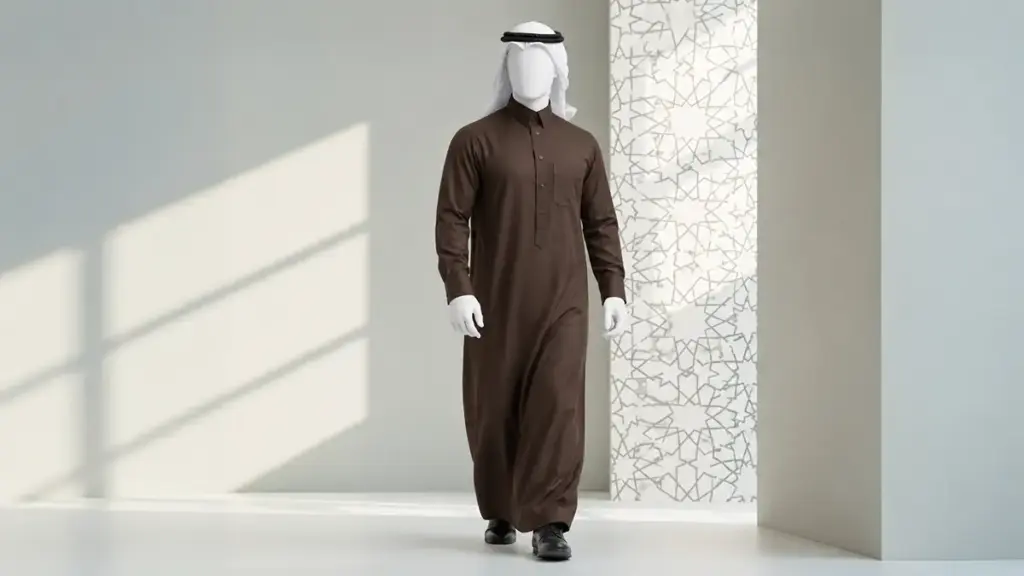
Exploring the history of the thobe and kandura, their evolution in modern fashion, and how advanced interlinings enhance structure, comfort and craftsmanship.
The traditional garment worn by men across the Arabian Peninsula—known variously as the thobe, kandura, or dishdasha—is far more than a piece of clothing. It is a powerful symbol of identity, heritage, and cultural pride. For centuries, this flowing robe has provided an elegant solution to the region’s harsh desert climate, embodying values of modesty, equality, and dignity. However, as the Gulf region transformed from a trading and pearl-diving hub into a global epicenter of modernity, its traditional attire evolved in tandem. Today, the thobe bridges generational divides, blending centuries-old traditions with cutting-edge textile innovations to meet the demands of contemporary life.
A Garment Born from Climate and Culture
The origins of the thobe are deeply rooted in the nomadic lifestyle of the Arabian desert, developing as a garment born directly from the interplay of climate and culture. Designed to offer protection from the intense sun and blowing sands, its loose fit allowed for maximum air circulation, providing a natural cooling effect. Historically, these garments were crafted from locally sourced materials, primarily lightweight cotton or linen, and stitched by hand to meet the survival needs of an arid environment.
While the fundamental silhouette remains consistent across the region, subtle variations emerged as distinct markers of national identity:
- The Saudi Thobe: Characterized by a tailored fit, a structured two-button collar, and double cuffs designed for cufflinks.
- The Emirati Kandura: Distinctive for its collarless neckline and a long, woven tassel known as the tarboosh or kazzouha, originally dipped in perfume.
- The Qatari Thobe: Recognizable by its sharp, stiff shirt-like collar (often a stiff single or double button) and its signature wide, prominent front placket, often paired with glossy, high-twist fabrics that hold a pristine glaze.
- The Kuwaiti Dishdasha: Defined by a narrow, high-reaching collar with a single button, a streamlined front placket, and a moderately tailored body that leans toward a highly polished, professional corporate appearance.
- The Bahraini Thobe: Appreciated for its loose, relaxed fit that prioritizes comfort in humid weather, typically featuring a soft shirt-like collar or collarless design with basic buttoning and simple placket lines.
- The Omani Dishdasha: Exceptionally unique, featuring a collarless neckline with a short, round tassel (furakha or kandoora) hanging just off-center to the right, often accompanied by intricate, minimalist embroidery around the neck and down the front placket.
For decades, the thobe served as a great equalizer. Whether worn by a king, a merchant, or a laborer, the uniform silhouette fostered a sense of communal solidarity. It was a garment born of necessity, refined by custom, and preserved as a sacred element of Khaleeji heritage.
The Modern Silhouette: Style and Structural Evolution
As the Gulf states entered an era of rapid urbanization and global integration, the thobe began to transition from a utilitarian garment into a statement of modern fashion. Today’s younger generation of designers and tailors are reimagining the classic robe, introducing slim-fit cuts, varied color palettes—such as deep blues, charcoals, and olives for winter—and subtle embroidery along the collar, plackets, and cuffs.
Craftsmanship and Engineering: The Role of Advanced Interlinings
The secret to a pristine modern thobe lies hidden beneath the surface. To achieve the crisp collars, rigid plackets, and perfectly defined cuffs that characterize premium tailoring, master artisans rely on advanced interlinings. These specialized fabric layers are fused or sewn between the outer textile and the inner lining, acting as the invisible skeleton of the garment.
In modern thobe construction, the choice of interlining directly dictates the balance between form and function:
- Structure and Silhouette: High-performance fusible interlinings provide the necessary stiffness to the collar and cuffs, ensuring they resist collapsing or fraying under stress.
- Drape and Fluidity: While the collar requires rigidity, the body of the thobe must retain its sweeping, fluid motion. Advanced interlinings are engineered to support the main fabric’s weight, allowing it to hang flawlessly without becoming stiff or boxy.
- Durability and Resilience: Traditional stiffeners often degraded after repeated laundering, leading to bubbling, blistering, or warping. Modern, high-quality interlinings are designed to withstand frequent washing and professional pressing, maintaining the garment’s crisp geometry over its lifetime.
Textile Technology: Enhancing Comfort in High Temperatures
Integrating structure into a garment worn in climates that routinely exceed 40°C (104°F) requires significant scientific innovation. Heavy, restrictive materials are impractical. Therefore, modern textile technology focuses on creating interlinings and fabrics that offer structural integrity while maximizing thermal comfort.
Leading manufacturers utilize multi-directional stretch and ultra-lightweight non-woven or woven interlinings. These materials feature advanced adhesive coatings applied in precise computer-generated dot patterns. This technique allows air to flow freely through the fused sections, preventing the buildup of trapped body heat around the neck and wrists.
Fabrisoul: Redefining the Invisible Art Behind Perfect Form
As modern fashion pushes the boundaries of traditional attire, creators and tailoring houses across the Gulf are turning to dedicated textile innovators to realize these sophisticated designs. At the forefront of this evolution is Fabrisoul, an industry specialist whose engineering works entirely beneath the surface to provide the invisible art behind modern garment shaping. Rather than acting as a mere stiffener, Fabrisoul serves as a core structural foundation, allowing the thobe to naturally contour while maintaining internal framework fluidity.
To combat the intense heat and heavy maintenance demands of the region, Fabrisoul introduces specialized Arabic Thobe Interlinings engineered explicitly for high-temperature pressing. This advanced production technology impacts the garment’s evolution in several ways:
- Advanced Thermal Bonding: By integrating precision thermal bonding with calibrated shrinkage and recovery rates, Fabrisoul creates a permanent, uniform bond with the face fabric. This completely eliminates fabric blistering and bubbling, which traditionally ruined the smooth surfaces of collars, cuffs, and plackets after washing.
- Ultra-Rigid, Resilient Geometry: Formulated to withstand heavy laundering and intense professional pressing, these specialized interlinings ensure that the signature crisp finish of the collar and cuffs remains sharp and intact throughout its lifespan, without degrading into fuzziness or losing structural memory.
- Uncompromising Material Quality: Utilizing premium ingredients, these materials deliver industrial-grade peel strength and heat resistance. This ensures the thobe retains an immaculate, wrinkle-resistant shape from morning boardrooms to evening events without altering the natural, sweeping drape of the outer textile.
- Backings for Tatreez: Dense tatreez embroidery warps light thobe fabrics without reinforcement. Fabrisoul embroidery interlinings absorb mechanical tension, ensuring distortion-free stitches. Clean-detaching tear-away or water-soluble backings eliminate bulk, keeping the chest panel soft and smooth against the skin.
By equipping manufacturers in the UAE, Qatar, Kuwait, Saudi Arabia, Bahrain, and Oman with these precise textile foundations, Fabrisoul bridges the gap between historical aesthetics and modern durability, ensuring the thobe remains structurally flawless without sacrificing comfort.
A Timeless Legacy Refined
The evolution of the Arabic thobe demonstrates that true tradition is not static; it is alive and adaptable. By embracing modern textile engineering and advanced structural craftsmanship, the thobe has successfully adapted to the fast-paced demands of the 21st century without sacrificing its cultural soul. It remains an enduring icon of Gulf heritage—perfected by history, refined by technology, and worn with timeless pride.